Production planning for manufacturers

Plan production you can actually run.

OptiLine builds each shift's plan from the parts on your shelves, the hours on your lines and the certified people on your floor. Then it ranks the work by what matters most to your customers and your margin.

OptiLine Revenue Analytics screen
OptiLine Weekly Plan screen

Most schedules fall apart on the floor, not on paper.

A plan that looks fine in a spreadsheet still breaks the moment it meets real stock, real people and a real shift.

The parts aren't there

The spreadsheet said there was stock. Two jobs were counting on the same bin.

The right person isn't on shift

The run needs a certified operator, and nobody checked who was actually in today.

The line was booked twice over

Every job fit on its own. Together they needed a 20-hour shift.

How it works

Four checks before anything hits the schedule.

OptiLine runs every candidate job through the same four checks your best planner does in their head, for every shift, in seconds.

  1. 1

    Parts

    Each run claims its components and subassemblies in rank order, so two runs never count on the same box of parts.

  2. 2

    Line time

    Runs share the shift's real minutes. When the line is full, the plan stops adding work.

  3. 3

    People

    A run only makes the plan if someone trained and certified for it is on that shift.

  4. 4

    Priority

    What's left is ranked by margin and the priority you set, per minute of line time, so the most valuable work goes first.

Anything that doesn't pass is listed with a plain-language reason, so you know exactly what to fix: a part to expedite, a person to schedule, or a run to move.

The product

One plan. Every team works from it.

From the weekly plan to the last shipment, production, supply chain and finance look at the same numbers.

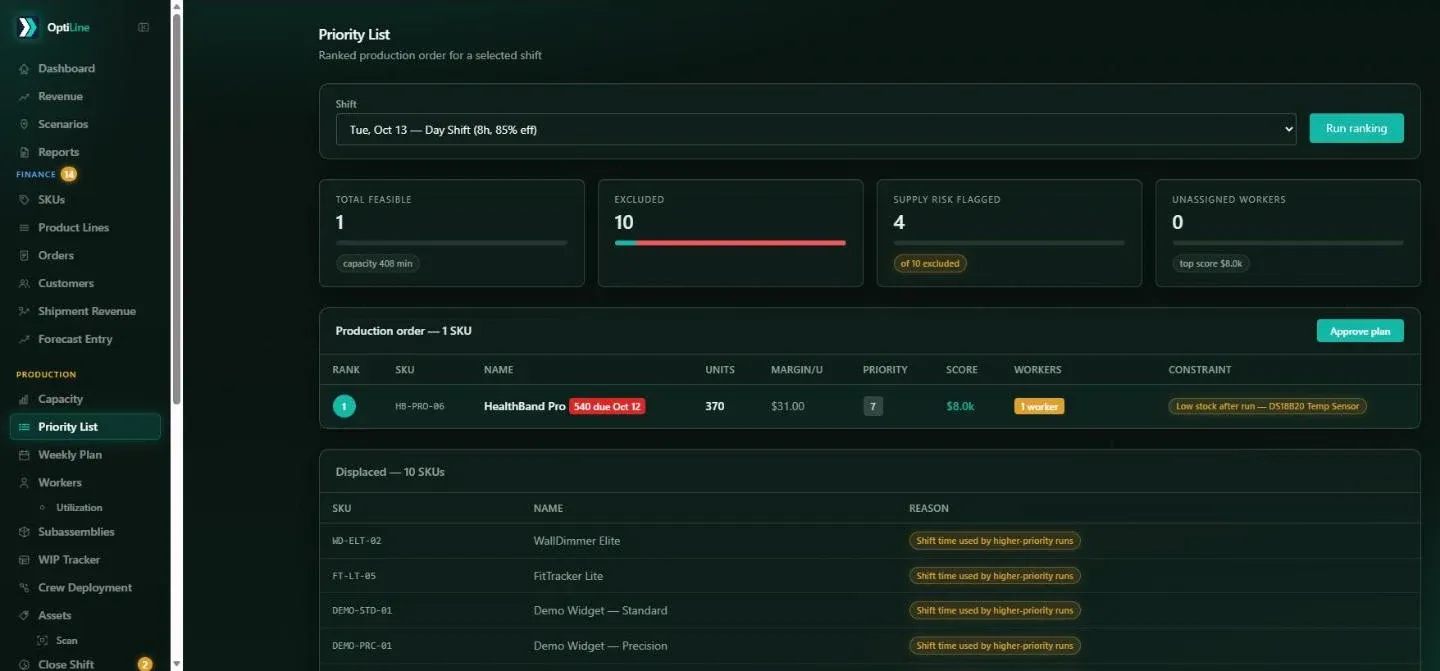
OptiLine Priority List screen

A ranked plan for any shift

Pick a shift and OptiLine ranks every product that could run on it, after checking parts, line time and who's on the crew.

  • Each run left out shows the reason: short parts, no qualified operator, or a full line
  • Override the order before you approve it
  • Approving reserves the parts each run needs
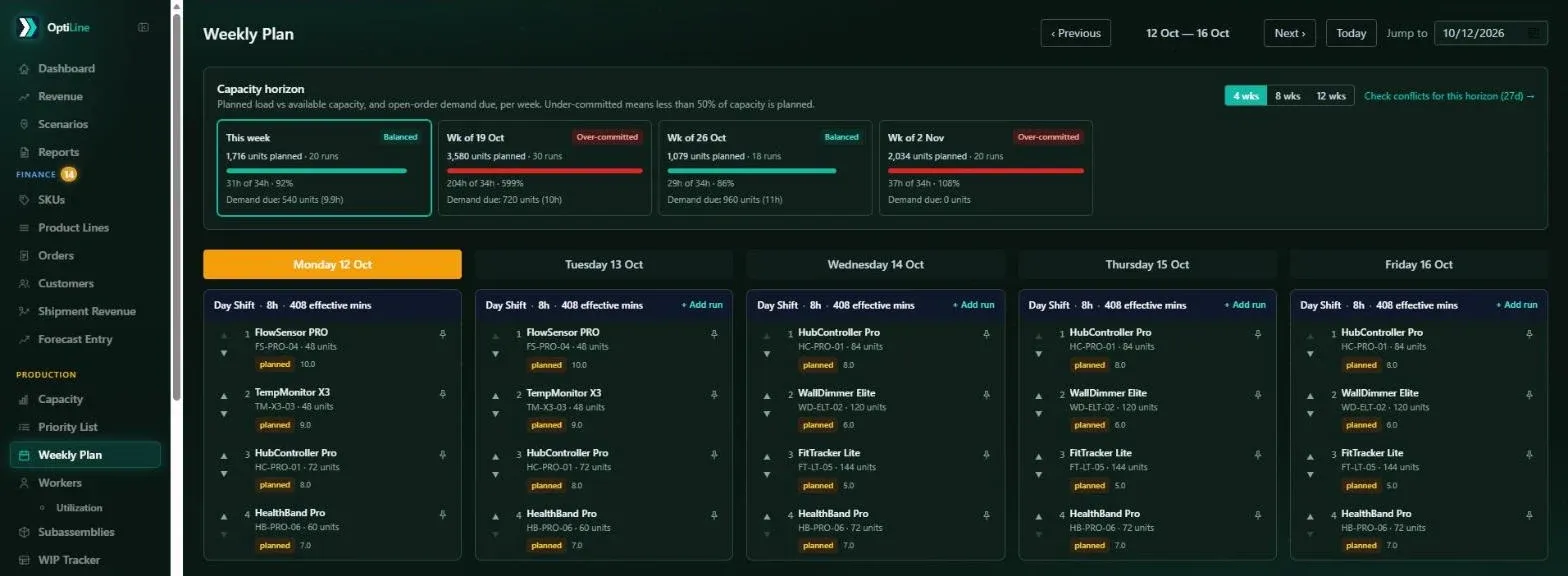
OptiLine Weekly Plan screen

The whole week, one screen

Every approved run by day and shift. Drag to reorder, or add a run by hand and pin it so re-planning leaves it alone.

  • 4, 8 or 12 weeks of planned hours against capacity
  • Each week flagged over- or under-committed against open orders
  • Jump from an empty shift straight to ranking it
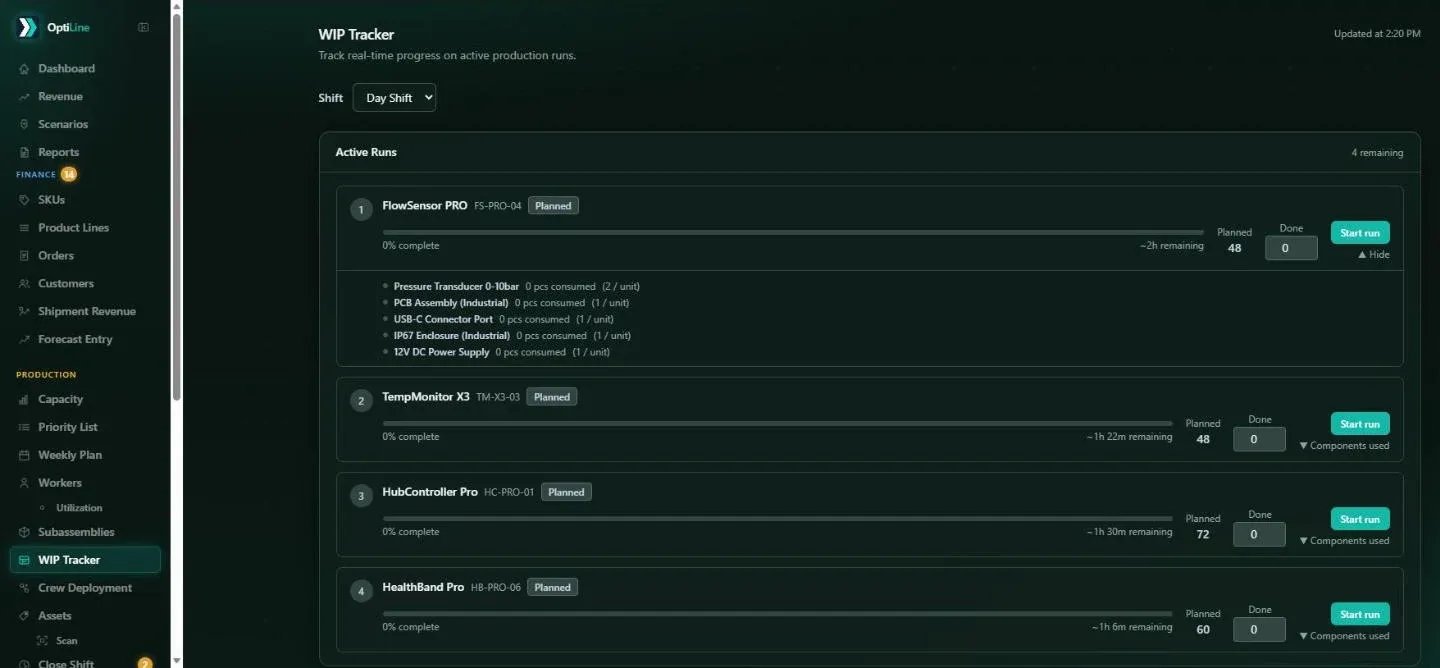
OptiLine Shift progress screen

Live progress on the floor

Each active run with units done so far. Runs complete themselves when they hit their target.

  • Start a run and log units as you go
  • See which components each run is using
  • Refreshes every minute on its own
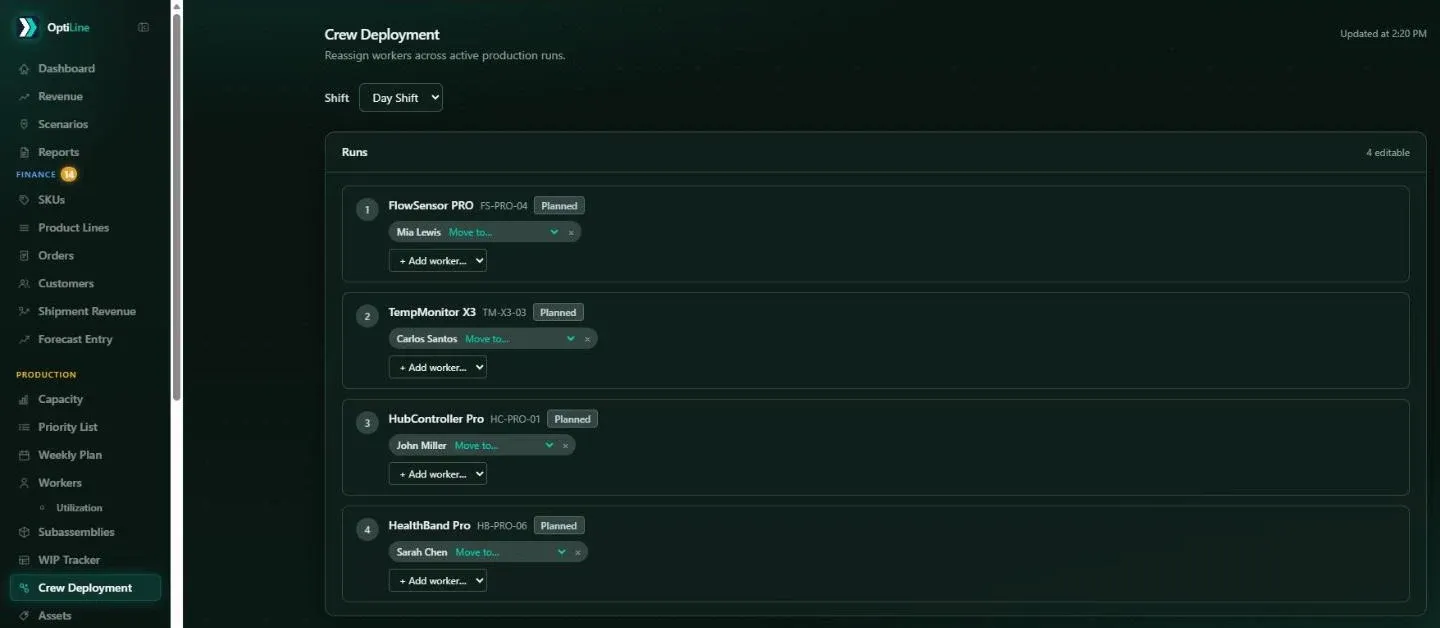
OptiLine Crew Deployment screen

Move people without breaking the rules

Add, move or remove workers on active runs mid-shift. The options only show people trained and certified for that run.

  • One click to move someone to another run
  • Qualification is re-checked on the server, not just in the menu
  • Preferred and backup workers per product
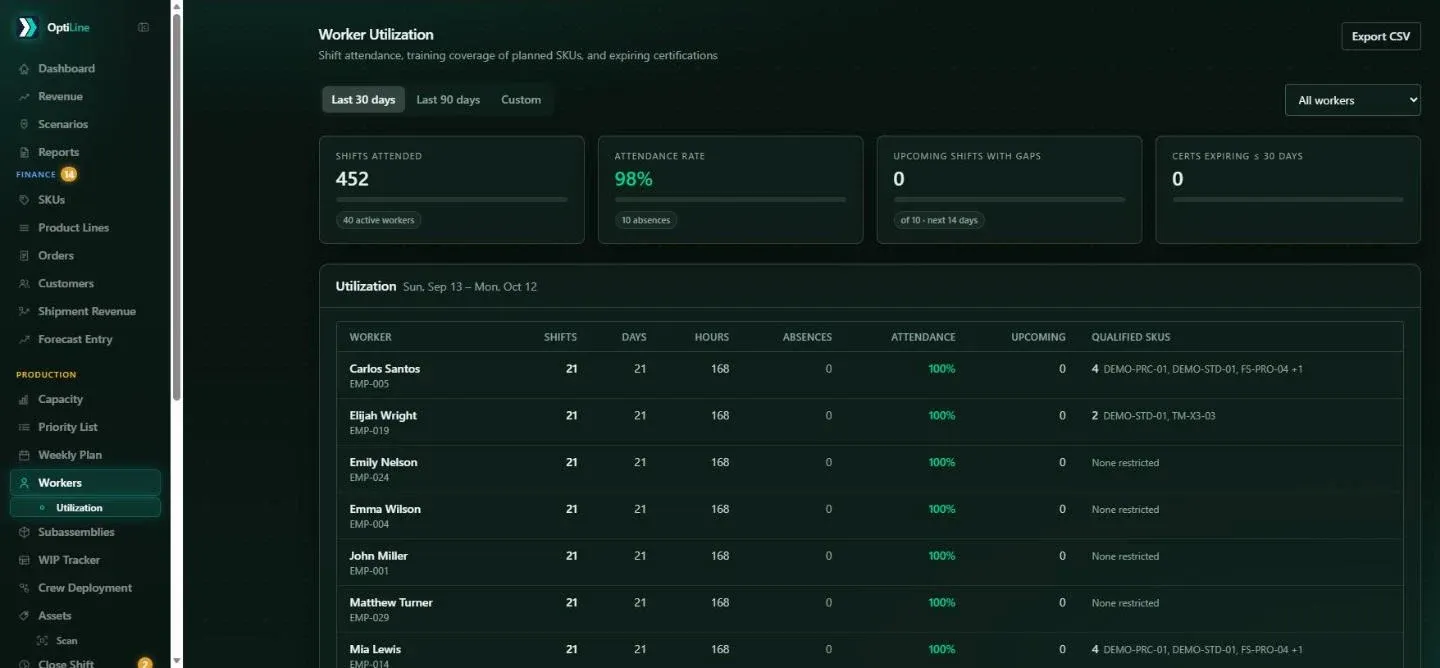
OptiLine Workers & training screen

Know who can run what

Training records with expiry dates, linked to the products and product lines that need them.

  • Certifications expiring in 30, 60 or 90 days
  • Products only one person can run, flagged before they're out sick
  • Shift attendance feeds straight into planning
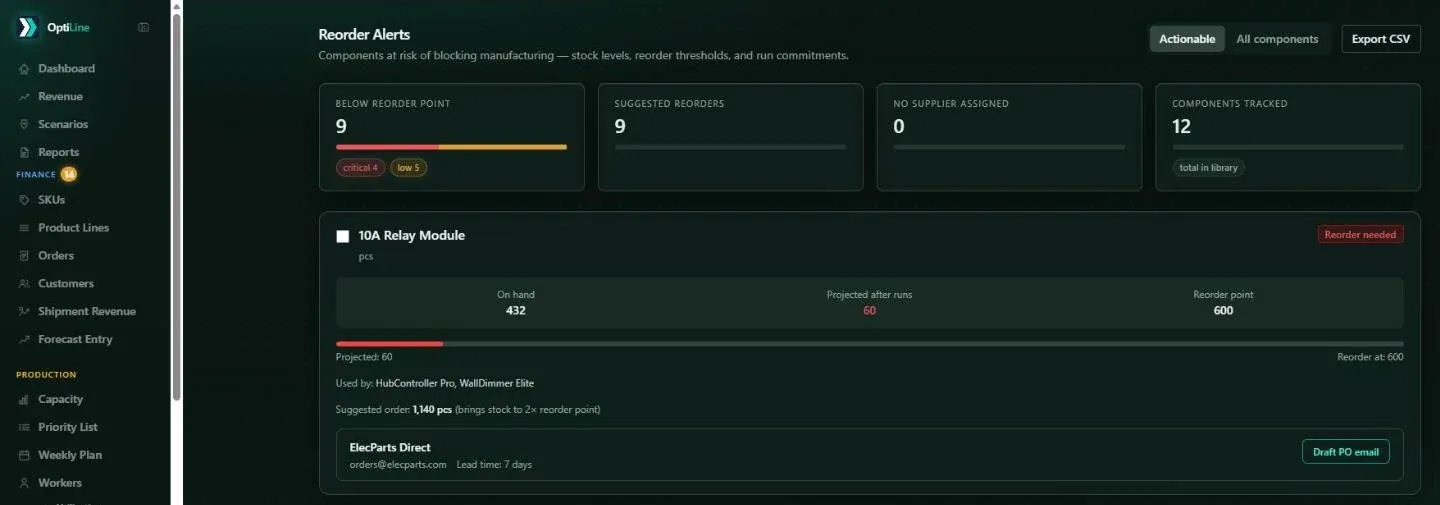
OptiLine Reorder Alerts screen

Order parts before the plan needs them

Projected stock subtracts what upcoming runs have already reserved, so alerts fire before the shelf is actually empty.

  • Suggested order quantities with a buffer you control
  • Group shortages by supplier into purchase orders
  • Receiving a PO adds the quantity straight to stock

Problems, before they're late

One list of everything that will go wrong in the next few weeks if nothing changes.

  • Orders at risk of missing their due date
  • Part shortfalls against planned runs
  • Shifts and weeks booked past capacity
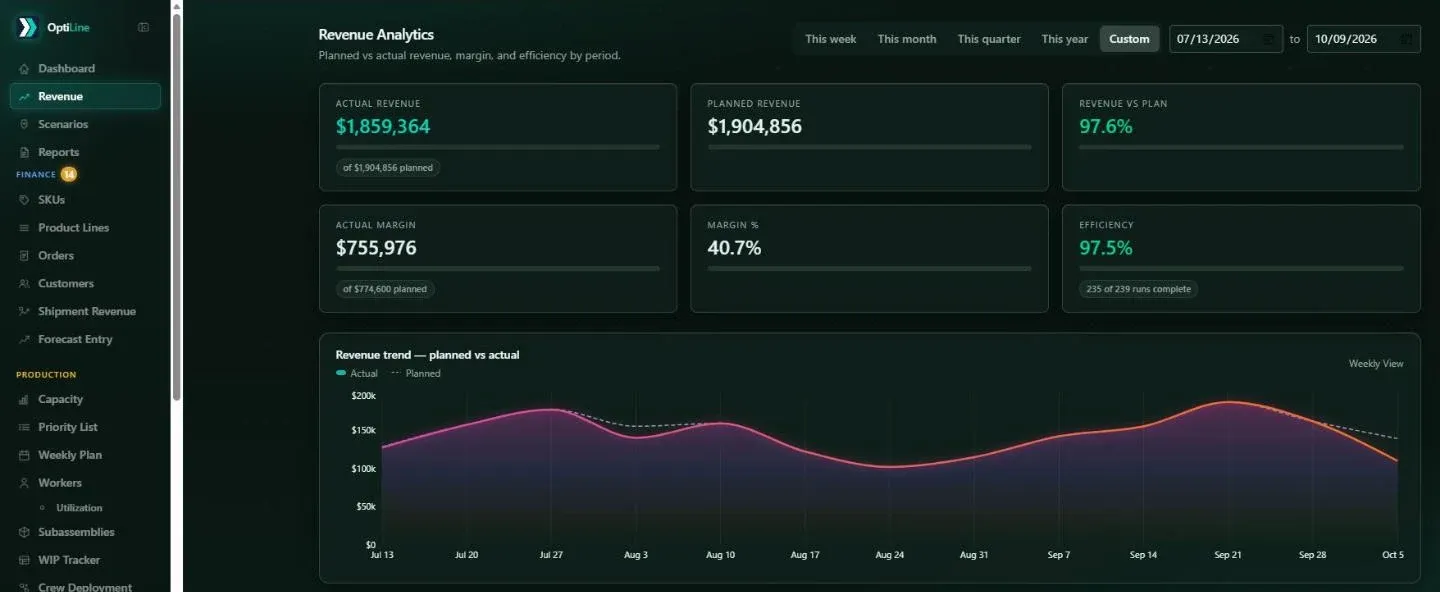
OptiLine Revenue screen

What the plan is worth

Planned versus actual revenue and margin, from the same runs the floor closes out each shift.

  • By week, month, quarter or a custom range
  • Break down by product or product line
  • Flags products missing a price, so totals aren't quietly wrong
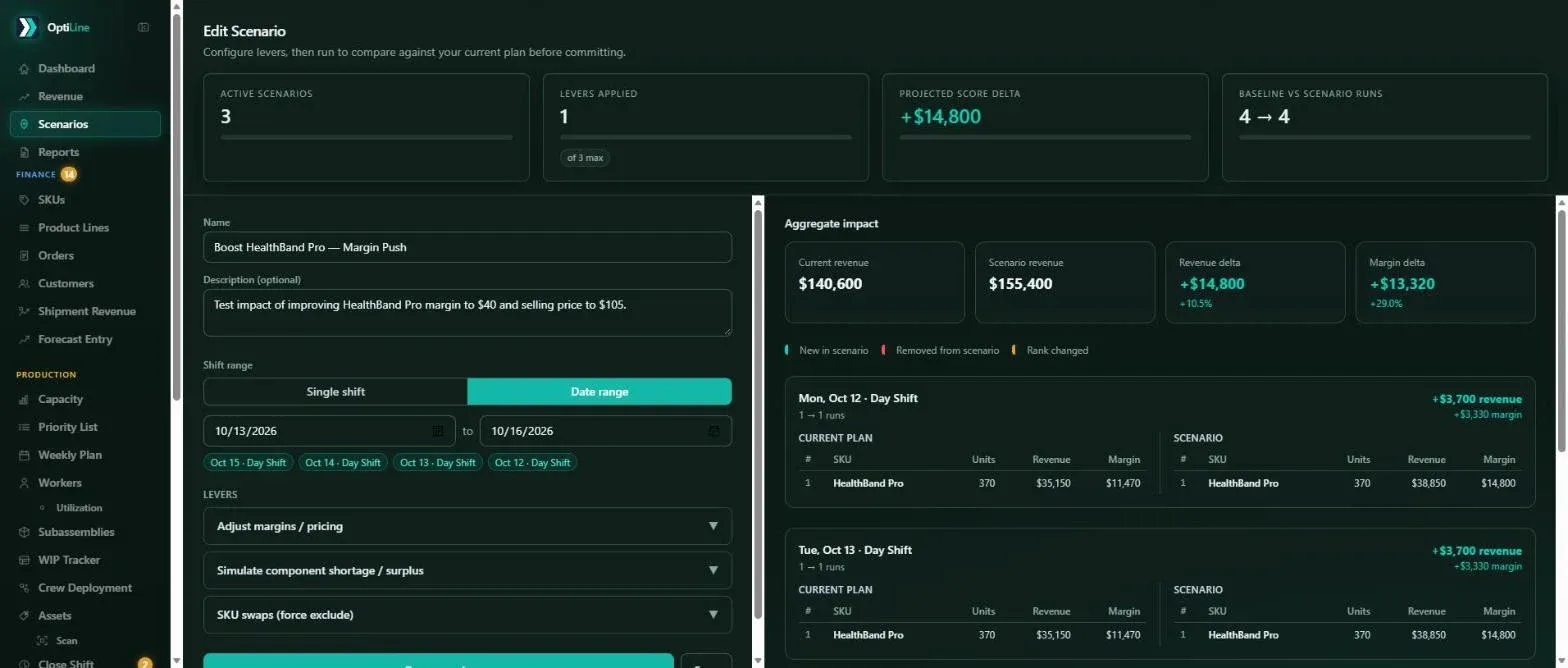
OptiLine Scenarios screen

Try it before you commit

Change prices, simulate a part shortage or drop a product, and compare the result with today's plan shift by shift.

  • Revenue and margin change at a glance
  • Runs added, removed or re-ranked are highlighted
  • Push the winning version to the live plan

Who it's for

Built for plants where the schedule is the hard part.

Three kinds of manufacturers, one engine underneath.

Contract manufacturers & job shops

Many customers, one set of lines.

When every customer's job is urgent, the plan has to show which ones you can actually build this week, with the parts and people you have, and what each one is worth.

  • Every order's due date and value in one backlog, with partial shipments
  • Runs ranked by margin and the priority you set per product
  • Parts reserved run by run, so two jobs never count on the same stock
  • Customer history with on-time delivery and open balance
  • Conflict alerts for orders heading toward a missed date
  • Import products, BOMs and orders from your spreadsheets

Problems it solves

  • Promising a date, then finding the parts went to another job
  • Rush orders that quietly push three others late
  • No clear answer to “which job makes us the most money this week?”

Equipment & machinery assembly

Built from parts, built from subassemblies.

A finished machine is only as ready as its slowest subassembly. OptiLine plans the layers together, so a shortage two levels down shows up before final assembly stalls.

  • Subassemblies with their own bills of materials and stock
  • Finished goods that pull from parts and subassemblies alike
  • Stock that moves as runs complete: parts out, assemblies in
  • Reorder alerts based on what upcoming runs have reserved
  • Purchase orders grouped by supplier and received into stock
  • QR and barcode scanning to claim, receive and count

Problems it solves

  • Final assembly waiting on a subassembly nobody scheduled
  • Shortages found on the line instead of in the plan
  • Stock counts that only change when someone remembers

Shops where certified operators matter

Welding, aerospace, medical devices.

If a job needs a certified welder or a trained operator, the schedule should know that before the shift starts, not after the run is already on the board.

  • Training requirements per product or product line
  • A run only makes the plan if a qualified person is on that shift
  • Expiring certifications at 30, 60 and 90 days
  • Products only one person can run, flagged ahead of time
  • Mid-shift crew moves limited to qualified workers
  • Every change recorded in an audit log

Problems it solves

  • A job scheduled on a shift with nobody certified to run it
  • A certification that lapsed without anyone noticing
  • One specialist who quietly holds up half the schedule

Fits how your plant already works.

Start from spreadsheets

Import SKUs, components, bills of materials and orders from CSV. Every row is checked and previewed before anything is saved.

Uses your barcodes

Already labeled with Code 128 or Code 39? OptiLine reads those, plus QR, from a phone camera.

Scan from a phone

Point a phone camera at a tag to claim parts, receive stock, count a bin or check out a tool. No scanner hardware needed.

Access by role

Production, supply chain and finance each see their own sections. Every change is recorded in an audit log.

Getting started

From spreadsheets to a ranked plan.

  1. 01

    Bring your spreadsheets

    Import products, components, bills of materials and open orders from CSV.

  2. 02

    Add lines, shifts and people

    Set your line capacity, shift times, and who's trained on what.

  3. 03

    Rank your first shift

    Open the Priority List, review the plan and the reasons behind it, and approve.

Questions, answered.

Do we have to replace our ERP or accounting system?

No. OptiLine plans and tracks production. It doesn't do accounting or invoicing. Today your data comes in through CSV import for products, components, bills of materials and customer orders, and every row is checked and previewed before anything is saved.

What does setup involve?

Mostly bringing over what you already keep in spreadsheets, then adding your lines, shifts, workers and who's trained on what. In the demo we'll use a few of your own products so you can see what that looks like for your plant.

Does it work with the barcodes we already use?

Yes. Scanning reads Code 128, Code 39, EAN, UPC, Data Matrix and QR codes from a phone camera, with no scanner hardware needed. You can also print new tags as QR, Code 128 or Code 39.

How does OptiLine handle certifications and training?

You set which training each product or product line needs and record each worker's training with an expiry date. Planning only schedules a run on a shift where someone qualified is present, and a report shows certifications expiring in the next 30, 60 or 90 days.

What happens when something changes mid-shift?

Re-plan the shift and OptiLine re-ranks everything that hasn't started, leaving in-progress, finished and pinned runs where they are. You can also move workers between runs on the spot, limited to people qualified for each one.

Can we plan subassemblies?

Yes. A subassembly has its own bill of materials and its own stock. A finished product's bill of materials can include both parts and subassemblies, and planning checks stock of both before it schedules a run.

Who can see what?

Access is by role. Production, supply chain and finance each get their own sections, and each company's data is kept completely separate. Every create, change and delete is recorded in an audit log.

Does it work on a phone?

Scanning is built for a phone camera, and the menu works on small screens. Planning and reporting screens are designed for a computer, where there's room to see the whole week.
See it with your own products.

Bring a few SKUs and a typical week. We'll show you what OptiLine would plan, and why.

Request a demo